
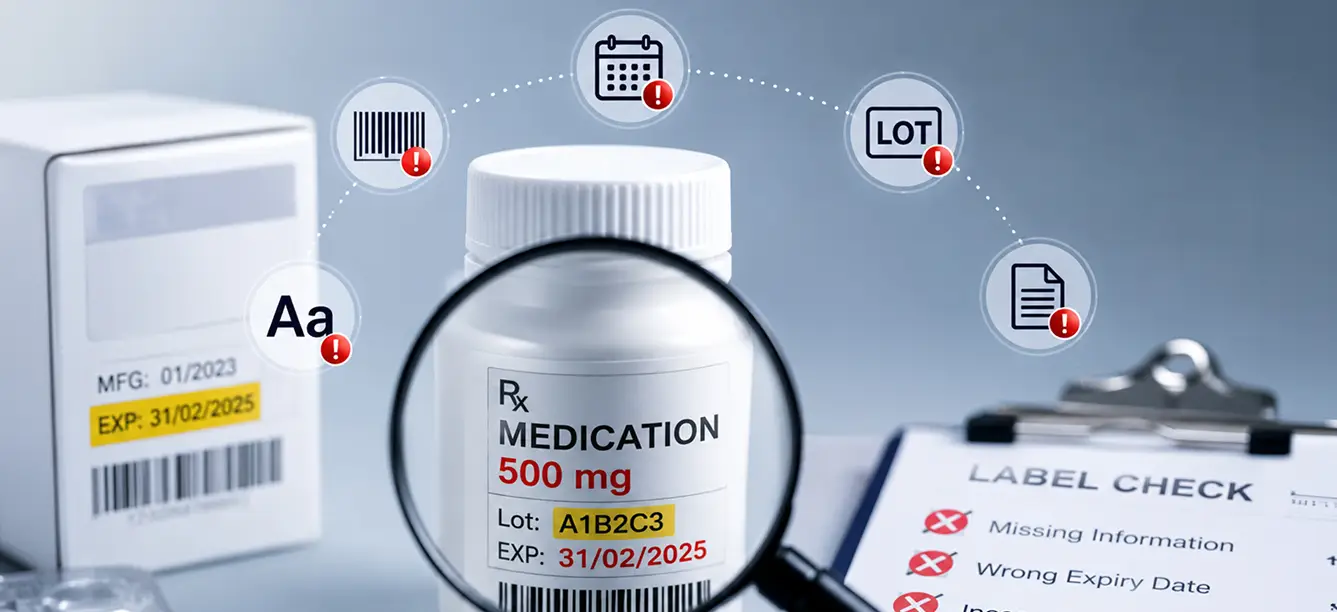
In the pharmaceutical industry, a product’s label is far more than a printed piece of packaging—it is a regulatory document that directly impacts patient safety.
Every barcode, dosage instruction, warning statement, expiry date, batch number, and ingredient declaration must be completely accurate. Even a minor artwork error can result in FDA observations, product recalls, regulatory penalties, financial losses, and damage to brand reputation.
Unfortunately, despite multiple review cycles, labeling mistakes continue to be one of the leading causes of pharmaceutical recalls worldwide. Manual proofreading, disconnected approval workflows, and inconsistent review standards make it difficult for organizations to detect every discrepancy before products reach the market.
As regulatory expectations continue to increase, pharmaceutical companies need smarter ways to validate labels with speed, consistency, and confidence.
This is where AI-powered artwork validation platforms like LabelSmart are changing the game.
Why Labeling Errors Lead to FDA Observations and Product Recalls
Regulatory agencies such as the FDA, EMA, MHRA, and other global authorities place significant emphasis on labeling accuracy because labeling directly affects patient safety.
Even a small error can cause:
- Incorrect medication usage
- Patient safety risks
- Product mix-ups
- Regulatory non-compliance
- Costly product recalls
- Import alerts or warning letters
- Loss of customer trust
Unlike manufacturing defects, labeling errors often remain unnoticed until products have already entered the supply chain—making corrections significantly more expensive.
Common Labeling Errors That Trigger Regulatory Actions
Although every company follows artwork approval procedures, several recurring issues continue to appear during inspections.
1. Incorrect Dosage or Strength Information
A missing decimal point or incorrect strength can completely change how a medicine is administered.
Example:
- 5 mg printed instead of 0.5 mg
- Wrong concentration displayed
These mistakes may lead to serious patient safety concerns.
2. Mismatch Between Primary and Secondary Packaging
The carton may display one batch number while the blister or bottle shows another.
Similarly,
- Wrong expiry date
- Incorrect manufacturing date
- Different product name
- Different pack size
These inconsistencies frequently become regulatory observations.
3. Missing Mandatory Regulatory Statements
Different countries require different mandatory declarations such as:
- Storage conditions
- Warning statements
- Pregnancy precautions
- Controlled substance information
- Serialization requirements
Missing even one mandatory statement may result in non-compliance.
4. Barcode or QR Code Errors
Unreadable or incorrect barcodes can disrupt:
- Warehouse operations
- Product traceability
- Supply chain management
- Product serialization
5. Artwork Version Control Issues
Many organizations maintain multiple versions of the same artwork.
Without proper controls, teams may accidentally approve:
- Older versions
- Incorrect revisions
- Obsolete packaging
This remains one of the most common causes of labeling-related recalls.
6. Font, Logo, and Formatting Inconsistencies
Small visual differences may appear insignificant but often indicate larger documentation control issues.
Examples include:
- Wrong font size
- Misaligned text
- Incorrect company logo
- Missing symbols
- Incorrect color coding
The Hidden Cost of Manual Artwork Review
Most pharmaceutical companies still rely heavily on manual review processes.
Multiple reviewers compare labels line by line, often using printed copies or PDF files.
This creates several challenges:
- Review fatigue
- Human interpretation differences
- Slow approval cycles
- Limited traceability
- Inconsistent validation across manufacturing sites
As artwork complexity increases, so does the likelihood of missing critical errors.
How AI is Transforming Pharmaceutical Label Validation
Artificial Intelligence is helping pharmaceutical companies move beyond traditional proofreading.
Modern AI systems can automatically compare artworks against approved templates, detect deviations, and ensure consistent validation across thousands of SKUs.
Instead of depending entirely on manual review, AI acts as an intelligent second reviewer—reducing human error while improving speed and consistency.
How LabelSmart Prevents Labeling Errors Before They Reach the Market
LabelSmart is an AI-powered artwork validation platform developed specifically for pharmaceutical packaging and regulatory compliance. It automatically checks pharmaceutical labels and artworks against regulatory, corporate, and product-specific standards using advanced image recognition and rule-based AI.
Key Capabilities
AI-Powered Artwork Validation
Automatically compares approved artworks with new versions to identify even the smallest deviations.
Intelligent Error Detection
Detects:
- Font changes
- Missing text
- Logo differences
- Alignment issues
- Symbol mismatches
- Content inconsistencies
before labels are approved.
Digital Audit Trail
Maintains complete electronic records of artwork reviews, making audit preparation easier while improving traceability.
Faster Packaging Approvals
Automates repetitive review tasks, helping organizations shorten artwork approval cycles and accelerate product launches.
Consistent Validation Across Global Operations
Ensures standardized label validation across multiple manufacturing sites, product lines, and geographies, reducing variability between reviewers.
Why LabelSmart is the Future of Pharmaceutical Packaging Compliance
Pharmaceutical labeling is becoming more complex every year.
New regulatory requirements, multilingual packaging, serialization mandates, and increasing product variations make manual validation increasingly difficult.
LabelSmart helps organizations:
- Reduce labeling-related recalls
- Improve regulatory compliance
- Standardize artwork validation
- Minimize human error
- Build digital audit readiness
- Accelerate product launches with greater confidence
Rather than replacing quality reviewers, LabelSmart empowers them with AI-assisted validation that is faster, more consistent, and highly reliable.
Conclusion
Labeling errors are among the most preventable causes of pharmaceutical recalls—yet they continue to affect manufacturers worldwide.
As packaging complexity grows, traditional manual review processes struggle to keep pace with increasing regulatory expectations.
AI-powered solutions like LabelSmart provide pharmaceutical companies with a smarter approach to artwork validation by detecting errors early, ensuring consistency, improving traceability, and strengthening compliance before products reach patients.
Ready to eliminate labeling errors before they become costly recalls? Connect with the Ai4Pharma team to discover how LabelSmart can modernize your pharmaceutical artwork review process.