
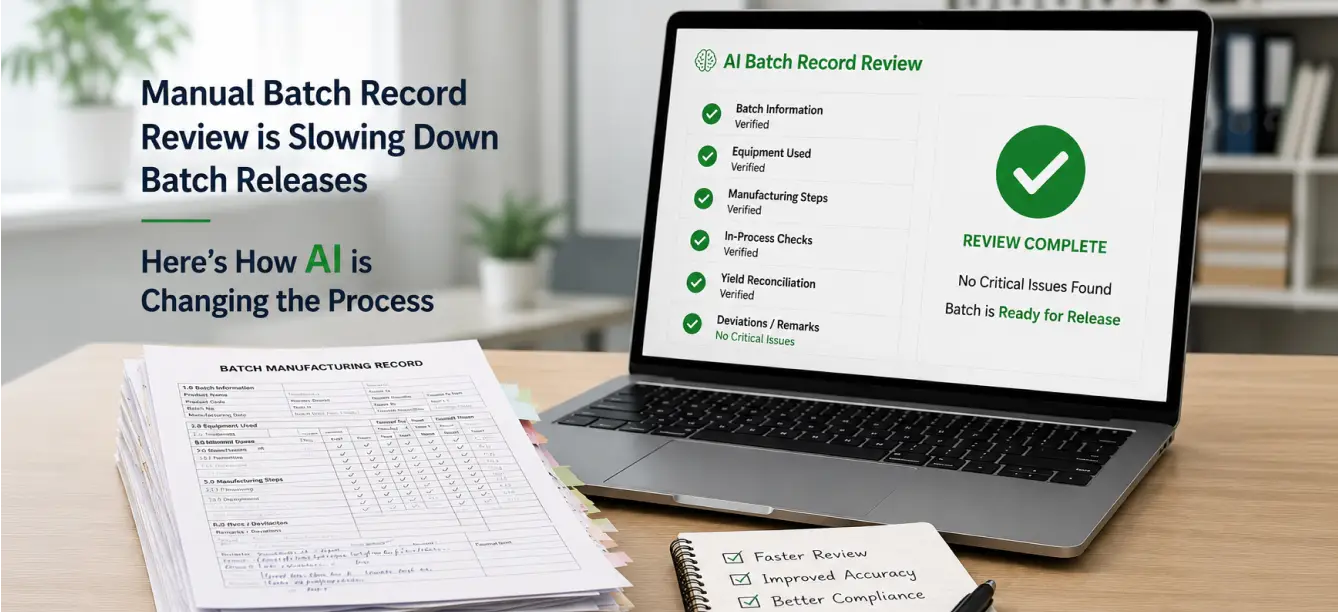
In pharmaceutical manufacturing, every completed batch represents months of planning, procurement, production, testing, and quality control. However, despite successful manufacturing, many batches remain stuck in Quality Assurance because of one critical bottleneck—manual Batch Manufacturing Record (BMR) review.
Quality teams spend hours or even days reviewing hundreds of pages of handwritten and printed records, verifying calculations, checking signatures, identifying missing entries, and ensuring every manufacturing step complies with GMP requirements.
While this process is essential for patient safety and regulatory compliance, it is also one of the most time-consuming and error-prone activities in pharmaceutical operations.
As production volumes increase and regulatory expectations become stricter, manual review is no longer sustainable.
This is where AI-powered batch record review platforms like BatchSmart are transforming pharmaceutical quality assurance.
Why Batch Release is a Critical KPI in Pharmaceutical Manufacturing
Batch release directly impacts:
- Product availability
- Inventory levels
- Revenue realization
- Customer commitments
- Supply chain continuity
- Regulatory compliance
Every additional day spent reviewing documentation delays products from reaching patients and ties up valuable working capital.
For many pharmaceutical companies, improving batch release timelines has become a strategic business priority—not just a quality objective.
The Challenges of Manual Batch Record Review
Traditional batch review involves manually checking every page of the Batch Manufacturing Record (BMR).
Reviewers verify:
- Manufacturing steps
- Process parameters
- Calculations
- Equipment details
- Operator signatures
- Date and time entries
- Deviations
- Corrections
- Yield calculations
For facilities producing hundreds of batches each month, this process can consume thousands of QA hours.
Manual review also introduces challenges such as:
- Human error
- Review fatigue
- Inconsistent verification
- Delayed approvals
- Limited visibility into recurring documentation issues
Common Documentation Errors That Delay Batch Release
Even well-trained production teams frequently make documentation mistakes that require QA intervention.
1. Missing Entries
Incomplete documentation remains one of the most common reasons batches cannot be released.
Examples include:
- Missing signatures
- Blank fields
- Incomplete manufacturing steps
- Missing dates
2. Incorrect Calculations
Errors in:
- Yield calculations
- Material reconciliation
- Process calculations
- Equipment readings
often require manual investigation before approval.
3. Out-of-Range Values
Production values recorded outside approved specifications require additional review, documentation, and investigation.
4. Documentation Inconsistencies
Examples include:
- Different batch numbers
- Incorrect product codes
- Wrong material references
- Inconsistent entries between sections
These discrepancies frequently delay QA approval.
5. Review Bottlenecks
As production volumes increase, QA reviewers simply cannot review every record with the same speed and consistency.
This creates:
- Batch backlogs
- Delayed market supply
- Increased workload
- Higher operational costs
The Hidden Cost of Delayed Batch Releases
The cost of delayed batch release extends far beyond QA.
It affects:
- Manufacturing efficiency
- Warehouse utilization
- Customer deliveries
- Cash flow
- Inventory carrying costs
- Production planning
More importantly, manual review often prevents quality teams from focusing on continuous improvement because they spend most of their time searching for documentation errors.
How AI is Transforming Batch Record Review
Artificial Intelligence is enabling pharmaceutical companies to automate repetitive documentation review while maintaining compliance.
Instead of manually reviewing every page, AI can analyze Batch Manufacturing Records, identify discrepancies, detect missing information, verify documentation consistency, and highlight potential risks for QA reviewers.
Rather than replacing quality professionals, AI acts as an intelligent assistant that enables faster and more consistent decision-making.
How BatchSmart Accelerates Batch Release While Improving Compliance
BatchSmart is an AI-powered platform that streamlines Batch Manufacturing Record (BMR) review by automatically identifying documentation errors, highlighting discrepancies, and providing real-time visibility into batch status. It helps QA teams accelerate batch releases while improving operational efficiency and regulatory compliance.
Key Capabilities
AI-Powered Batch Record Review
Automatically analyzes Batch Manufacturing Records and highlights documentation gaps for faster review and approval.
Intelligent Discrepancy Detection
Identifies:
- Missing documentation
- Incorrect entries
- Repeated documentation errors
- Batch inconsistencies
allowing reviewers to focus only on exceptions instead of every page.
Real-Time Batch Status
Provides dashboards showing:
- Cleared batches
- Pending batches
- Batches requiring review
- Documentation gaps
giving QA managers complete visibility across operations.
Error Analytics
Tracks recurring documentation issues, helping organizations identify training needs and continuously improve documentation quality.
Faster Batch Release
By reducing manual review effort, BatchSmart enables quicker approvals without compromising GMP compliance or quality standards.
Why BatchSmart is the Future of Pharmaceutical Quality Assurance
As pharmaceutical manufacturing scales, QA teams must review more batches without compromising compliance.
BatchSmart enables organizations to:
- Reduce manual review effort
- Accelerate batch release
- Improve documentation accuracy
- Standardize review processes
- Increase visibility across manufacturing sites
- Build data-driven quality improvement programs
By combining AI with pharmaceutical quality expertise, BatchSmart transforms batch review from a manual bottleneck into a faster, smarter, and more proactive quality process.
Conclusion
Manual Batch Manufacturing Record review has long been one of the biggest challenges in pharmaceutical quality assurance. As production volumes grow and regulatory expectations increase, relying solely on manual review becomes increasingly difficult.
AI-powered platforms like BatchSmart help pharmaceutical companies modernize batch review by identifying documentation errors early, accelerating batch release, providing actionable insights, and enabling quality teams to focus on higher-value activities.
Ready to accelerate your batch release process while strengthening GMP compliance? Connect with the Ai4Pharma team to discover how BatchSmart can transform your Batch Manufacturing Record review process.